The Invisible Flood: How Application-Layer API Attacks Are Defeating Traditional DDoS Defenses
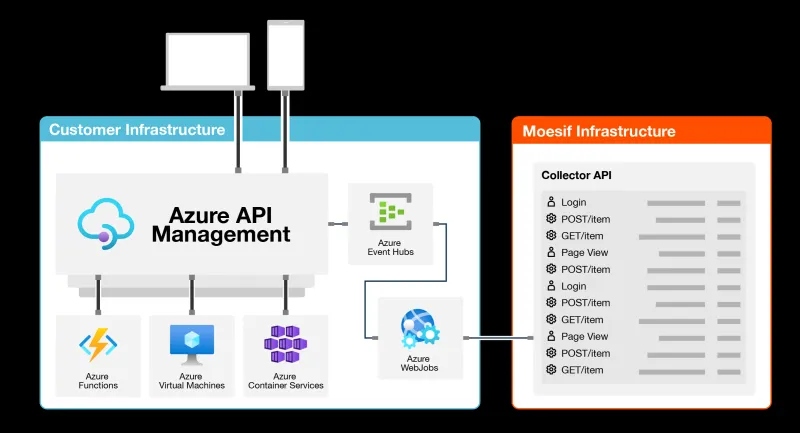
Photo: API security application layer network attack cybersecurity code monitor, via blog.moesif.com
For more than two decades, the dominant mental model of a DDoS attack has been the flood: a torrent of packets so large that it saturates pipes, overwhelms routers, and renders services unreachable through sheer volume. That model shaped an entire generation of defensive tooling — scrubbing centers calibrated to detect volumetric anomalies, rate limiters tuned to catch connection surges, and network-layer firewalls designed to drop traffic at scale.
Attackers have noticed. And they have adapted.
The fastest-growing category of denial-of-service activity in 2024 and into 2025 does not announce itself with gigabits of traffic. It arrives quietly, through the same HTTPS endpoints that serve legitimate customers, using the same request formats that production applications expect. The target is not the network pipe. The target is the API — and the computational cost of processing a single maliciously crafted request can be orders of magnitude higher than the cost of sending it.
Why APIs Are the New Attack Surface
The migration of American business logic to API-first architectures has been one of the defining infrastructure trends of the past decade. Retail platforms expose APIs for inventory and pricing. Financial services firms route transactions through microservice endpoints. Healthcare systems transmit patient data via REST and GraphQL interfaces. In each case, the API is not merely a convenience layer — it is the operational backbone of the business.
This centrality makes APIs an extraordinarily attractive target. A successful denial-of-service against a core API endpoint does not just slow a website. It can halt order processing, disable authentication services, freeze payment pipelines, or prevent clinicians from accessing patient records. The blast radius of a well-targeted API attack can exceed that of a conventional volumetric flood, achieved with a fraction of the traffic volume.
Attackers have also recognized that API endpoints frequently expose computationally expensive operations: complex database queries, authentication token validation, third-party service calls, and cryptographic operations. A request that costs the attacker microseconds to generate may cost the target server hundreds of milliseconds to process. That asymmetry is the weapon.
Case Studies: When the Flood Went Quiet
Several high-profile incidents in recent years illustrate the operational reality of this threat vector.
A mid-sized American e-commerce company experienced what its operations team initially classified as a performance degradation event — response times climbing, checkout completions dropping, customer complaints accumulating. Traffic volume appeared normal. No volumetric alerts fired. It took nearly four hours to identify that a single product search endpoint, which triggered a complex inventory aggregation query, was being called at a rate roughly forty times above baseline. The requests were syntactically valid. They originated from thousands of distinct IP addresses. The attack was invisible to every tool calibrated to look for volume.
In a separate incident, a financial technology firm offering payment processing services was targeted through its account authentication API. Attackers submitted credential-validation requests at a sustained rate that kept the authentication service perpetually resource-constrained without triggering any volumetric threshold. Legitimate users experienced intermittent login failures that support teams initially attributed to a software defect. The attack persisted for over six hours before the correct diagnosis was made.
These cases share a common thread: the absence of a volumetric signature rendered conventional detection mechanisms effectively blind.
Why Legacy Tools Cannot See the Threat
Traditional DDoS mitigation platforms are architected around a core assumption — that an attack will be distinguishable from legitimate traffic by its volume, its packet characteristics, or its geographic origin. That assumption was reasonable when the predominant attack vectors were UDP floods, SYN floods, and amplification attacks. It is not reasonable for application-layer API abuse.
A request to a GraphQL endpoint that asks for a deeply nested, computationally expensive data structure looks, at the network layer, identical to a routine query from a mobile application. Rate-based detection fails when attackers distribute requests across a large botnet, keeping per-IP rates below threshold. IP reputation filtering fails when the attacking infrastructure includes residential proxies or compromised legitimate cloud accounts. Geographic filtering fails when attackers deliberately route traffic through jurisdictions the target organization cannot afford to block.
The result is a detection gap that grows wider as API architectures become more complex and as attackers become more deliberate in mimicking legitimate usage patterns.
Detection Strategies for Security Teams
Addressing this gap requires a fundamental shift in the signals security teams monitor. Rather than asking "how much traffic is arriving," effective API attack detection asks "what is the computational cost of the traffic that is arriving" and "how does the current request pattern compare to established behavioral baselines."
Several specific approaches merit adoption.
Request complexity scoring assigns a cost weight to different API operations based on their known server-side resource consumption. Endpoints that trigger expensive database joins, external service calls, or cryptographic operations are monitored against tighter thresholds than lightweight read operations.
Behavioral baseline modeling establishes normal usage patterns for each API endpoint — call frequency, parameter distributions, session context, and client fingerprints — and generates alerts when observed patterns deviate materially from the baseline. Machine learning approaches are particularly effective here, as they can identify subtle distributional shifts that rule-based systems would miss.
Client fingerprinting beyond IP address incorporates TLS handshake characteristics, HTTP/2 stream behavior, user-agent consistency, and request header ordering to build richer client profiles. Attackers who successfully rotate IP addresses frequently fail to rotate these lower-level behavioral signals.
Query depth and complexity limits at the API gateway layer can prevent the most egregious forms of computational amplification, particularly for GraphQL interfaces where recursive query structures are a well-documented attack vector.
Architectural Changes That Reduce Exposure
Detection alone is insufficient. Security teams must also advocate for architectural decisions that structurally reduce API attack surface.
Decomposing monolithic APIs into tiered service layers — with lightweight authentication and rate-limiting occurring before requests reach computationally expensive backend services — limits the damage any single endpoint can sustain. Caching responses to frequently repeated queries eliminates the computational leverage that attackers depend on. Implementing asynchronous processing for expensive operations, rather than blocking synchronous responses, reduces the immediate resource impact of request floods.
API gateways with native abuse detection capabilities, positioned upstream of application servers, provide an enforcement point that can absorb and filter malicious traffic before it reaches the infrastructure it is designed to exhaust.
Defending What Legacy Tools Cannot See
The shift toward application-layer API attacks represents a maturation of adversarial technique — a deliberate exploitation of the gap between how defenders have built their tooling and how modern application infrastructure actually works. American organizations that have invested heavily in volumetric DDoS mitigation without revisiting their API security posture are operating with a significant and largely invisible blind spot.
Closing that gap demands a willingness to retire assumptions that no longer hold, instrument the application layer with the same rigor historically applied to the network layer, and treat API behavioral anomalies as a first-class security signal. The flood has not disappeared — it has simply learned to wear a disguise.